
Pigmentation, Tattoo & Hair Removal · Seomyeon, Busan
Age Spot Removal in Busan
#AgeRelatedPigmentation · #RaisedAgeSpots · #ClearSkinTone · #LaserRemoval
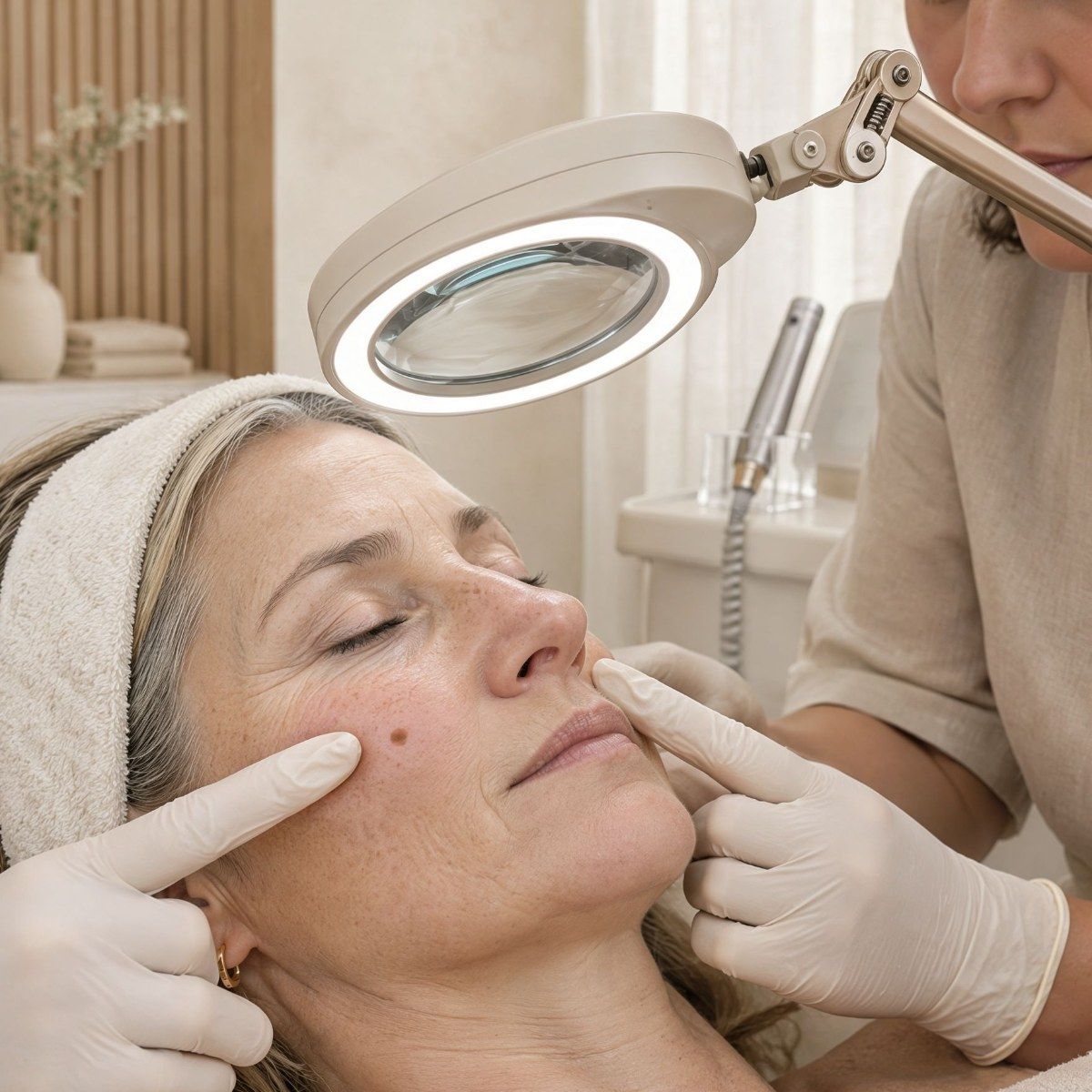
Age spots here mean thicker, raised pigmented spots that develop with age and sun exposure, removed precisely with a laser. The laser is set to the thickness and size of each spot to help restore a clearer, more even skin tone.
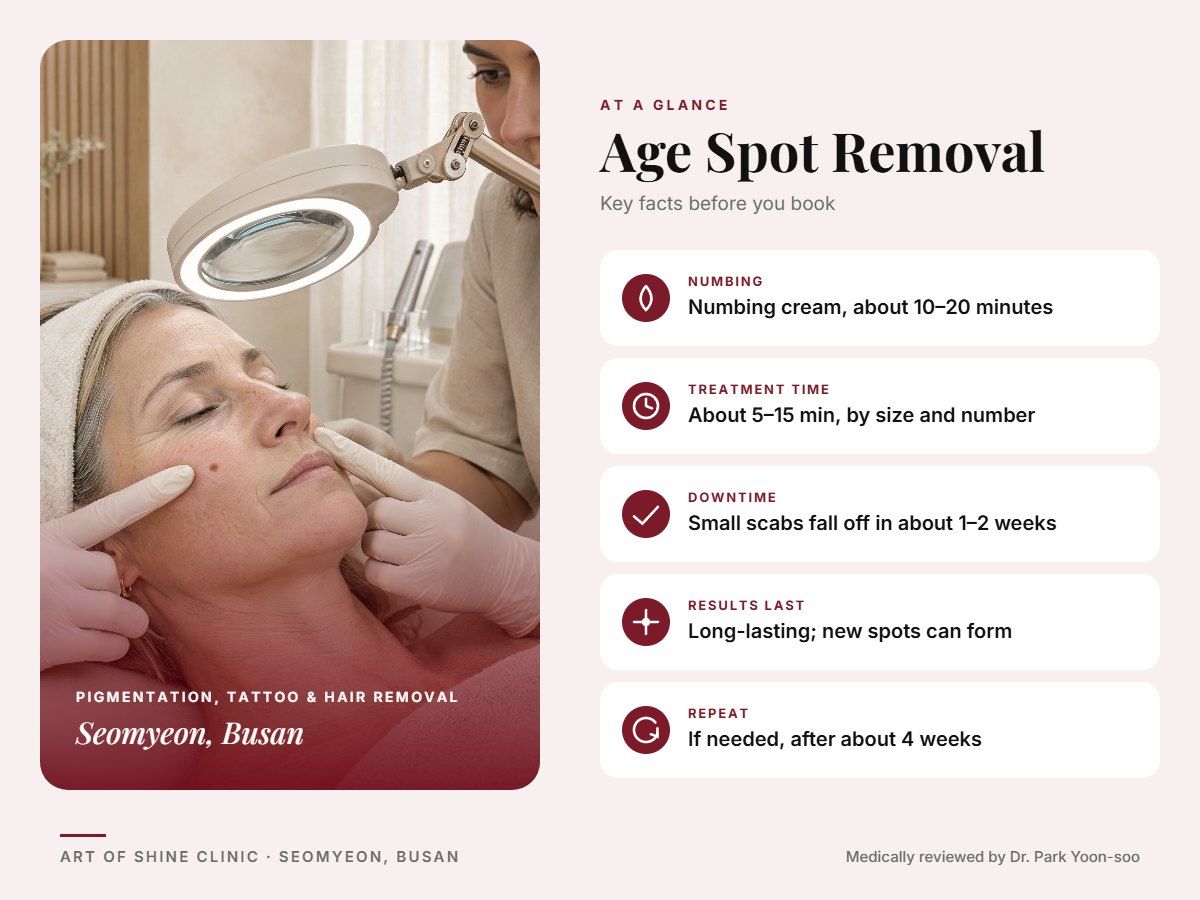
Quick answer: Age spot removal uses a laser to precisely remove thick, raised pigmented spots that appear with age and sun exposure. At Art of Shine Clinic in Seomyeon, Busan, numbing cream is applied for 10–20 minutes, then treatment takes about 5–15 minutes. A small scab forms and falls off in about 1–2 weeks. Removed spots usually stay away, though new ones can form. Prices start from KRW 190,000 (excl. 10% VAT).
At a glance
Numbing
Treatment time
Downtime
Results last
Repeat
✔ Medically reviewed byDr. Park Yoon-soo, Head Director, Art of Shine Clinic · Last reviewed:

What is Age Spot Removal?
Raised age spots are often seborrhoeic keratoses: harmless, thickened, pigmented growths that tend to appear on the face, hands and body from middle age. Flat sun spots (solar lentigines) are related but sit flatter in the skin. Your doctor examines each spot first, and any spot that looks unusual is checked before treatment.
Thicker, raised spots are usually removed with an ablative laser such as CO2, while flatter pigment can respond to pigment lasers like Clarity II or Pico Toning. Smaller raised bumps may also suit milia, skin tag and wart removal.
How Age Spot Removal works
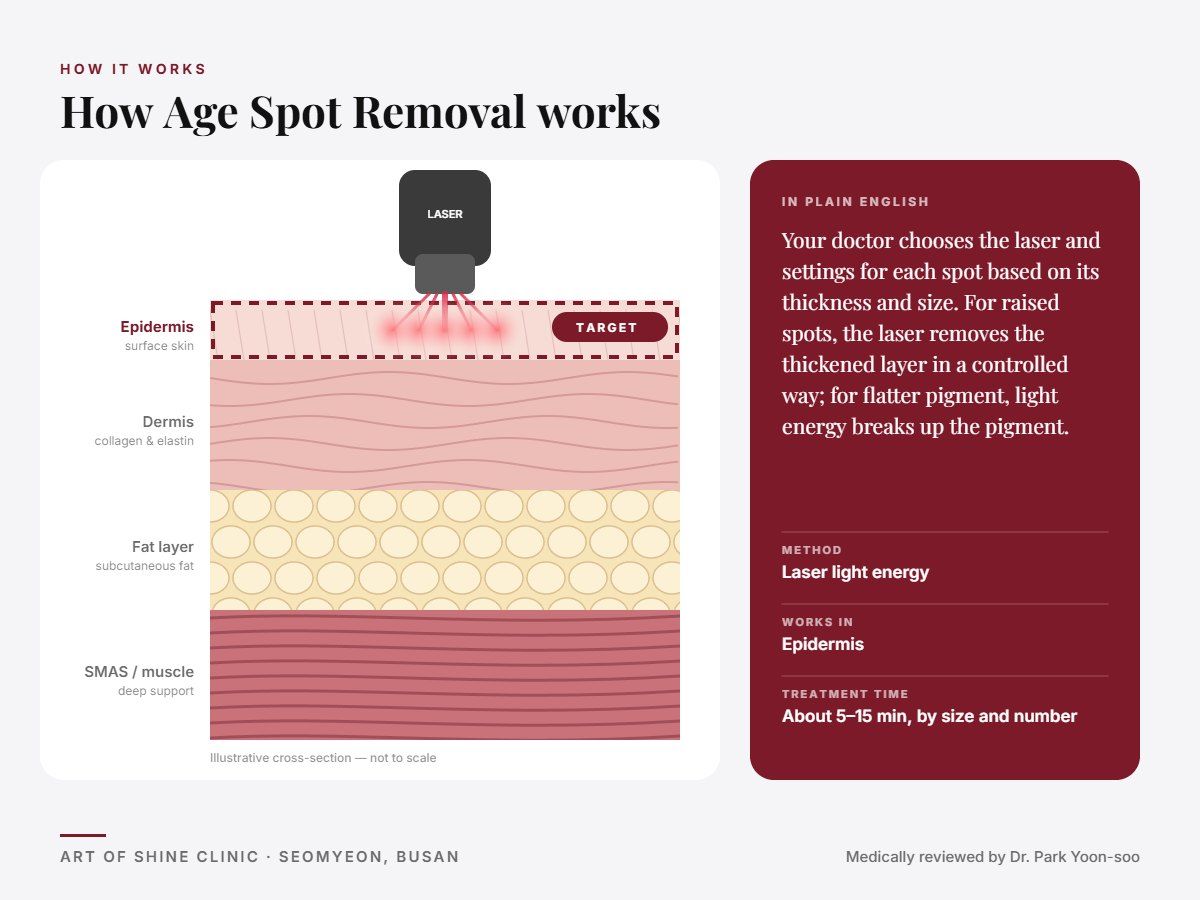
Your doctor chooses the laser and settings for each spot based on its thickness and size. For raised spots, the laser removes the thickened layer in a controlled way; for flatter pigment, light energy breaks up the pigment. A thin scab forms as the skin heals underneath.
- Consultation: your doctor examines each spot, confirms it is suitable and plans the laser.
- Treatment: after numbing cream, the laser treats each spot, usually in about 5–15 minutes.
- After: ointment is applied; a small scab forms and falls off naturally in about 1–2 weeks.
Why patients choose Age Spot Removal
- Precise removal — targets thick, raised spots one by one.
- Tailored to each spot — laser and settings match lesion thickness and size.
- Quick appointment — most spots are treated in a single short session.
- Clearer, more even tone — fewer spots that makeup struggles to cover.
Who is Age Spot Removal for — and when we suggest something else
Good candidates
- You have thick, raised brown spots that have appeared with age.
- Makeup no longer covers certain spots well.
- The number of spots on your face or hands has grown over the years.
- You can accept small scabs for about 1–2 weeks.
- You want spots removed in one visit, with a check-up later if needed.
- You are willing to use sunscreen daily afterwards to limit new spots.
We may suggest something else if…
- Your pigment is flat and spread out, like melasma. Toning such as Pico Toning or Helios 4 suits that better.
- The growth is a mole rather than an age spot. Mole Removal uses a different approach.
- The bumps are small, yellowish and grainy. They may be sebaceous hyperplasia; see Sebaceous Hyperplasia Removal.
- A spot has changed quickly, bleeds, itches or looks irregular. Dr. Park will advise having it medically checked before any laser removal.
- You have a beach holiday or major event within the next 2 weeks. Scabs and new skin need sun protection, so waiting may be wiser.
What happens at your Age Spot Removal session in Seomyeon
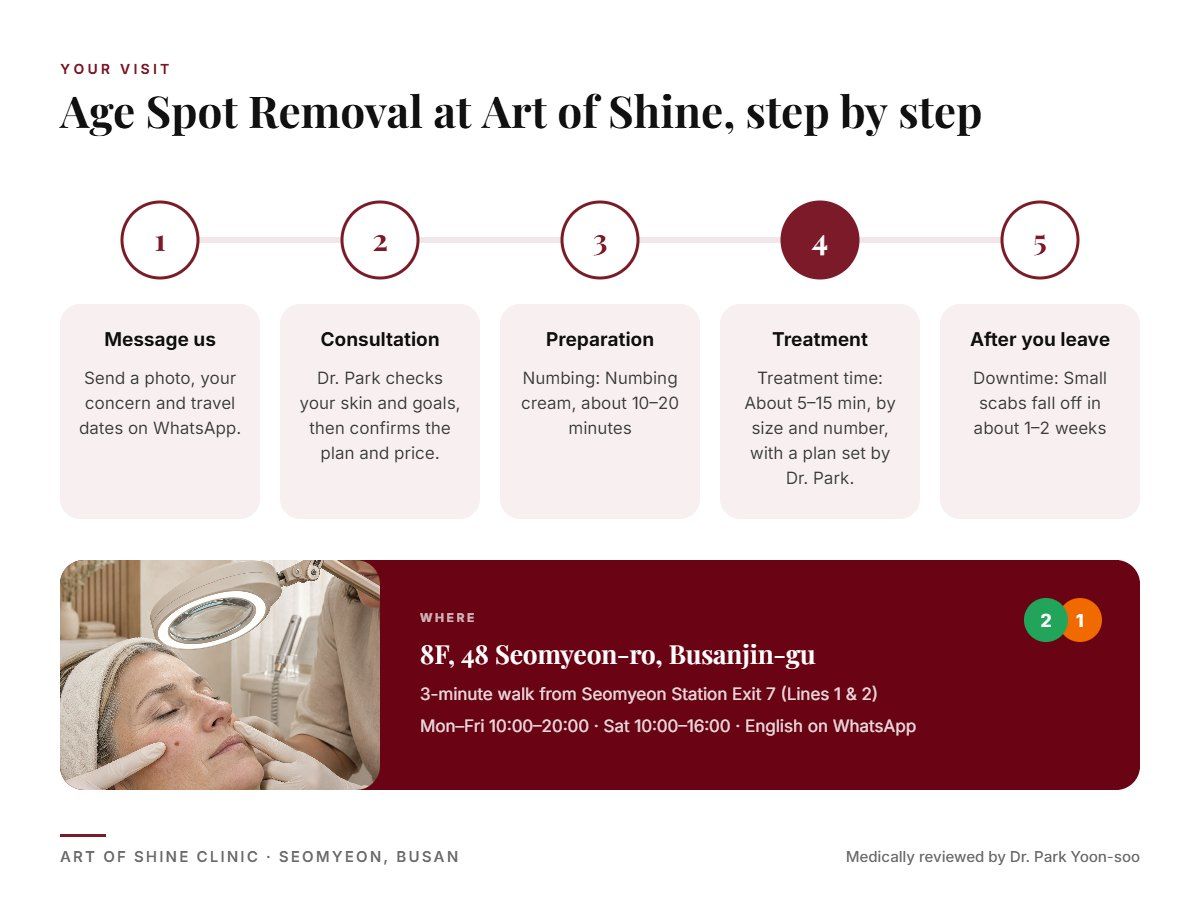
- Message us on WhatsApp first. Send clear photos of the spots in daylight, and tell us how many you want treated. Mention your flight date.
- Consultation with Dr. Park. Dr. Park examines each spot to confirm it suits laser removal. She checks thickness, size and anything unusual.
- Preparation & numbing. Numbing cream or local anaesthesia is applied, taking about 10–20 minutes.
- The treatment. The laser removes each spot layer by layer, taking about 5–15 minutes depending on the number. You feel warmth or quick snaps.
- Out the door & follow-up. Small scabs form and fall off in about 1–2 weeks. If a spot remains, a follow-up can be planned after 4 weeks.
How Dr. Park plans your Age Spot Removal treatment
Matching the laser to the lesion
Thick, raised spots are usually removed directly with a laser such as CO2. Dr. Park sets the depth to the thickness of each spot. Thin spots are treated more lightly to protect the surrounding skin.
Spots plus overall tone
Many patients have a few raised spots and flatter pigment around them. Packages reflect this. The One-Day Spot-Clearing Laser combines Clarity Laser, Laser Toning and CO2 for up to 15 spots. The Signature package pairs Full-Face Pigment Removal x1 with Pico Toning x5 and LDM x5.
Follow-up
Some thick spots need a second pass. If needed, retreatment is recommended after 4 weeks. Removed spots usually do not return, but new ones can appear, so sun protection is part of the plan.
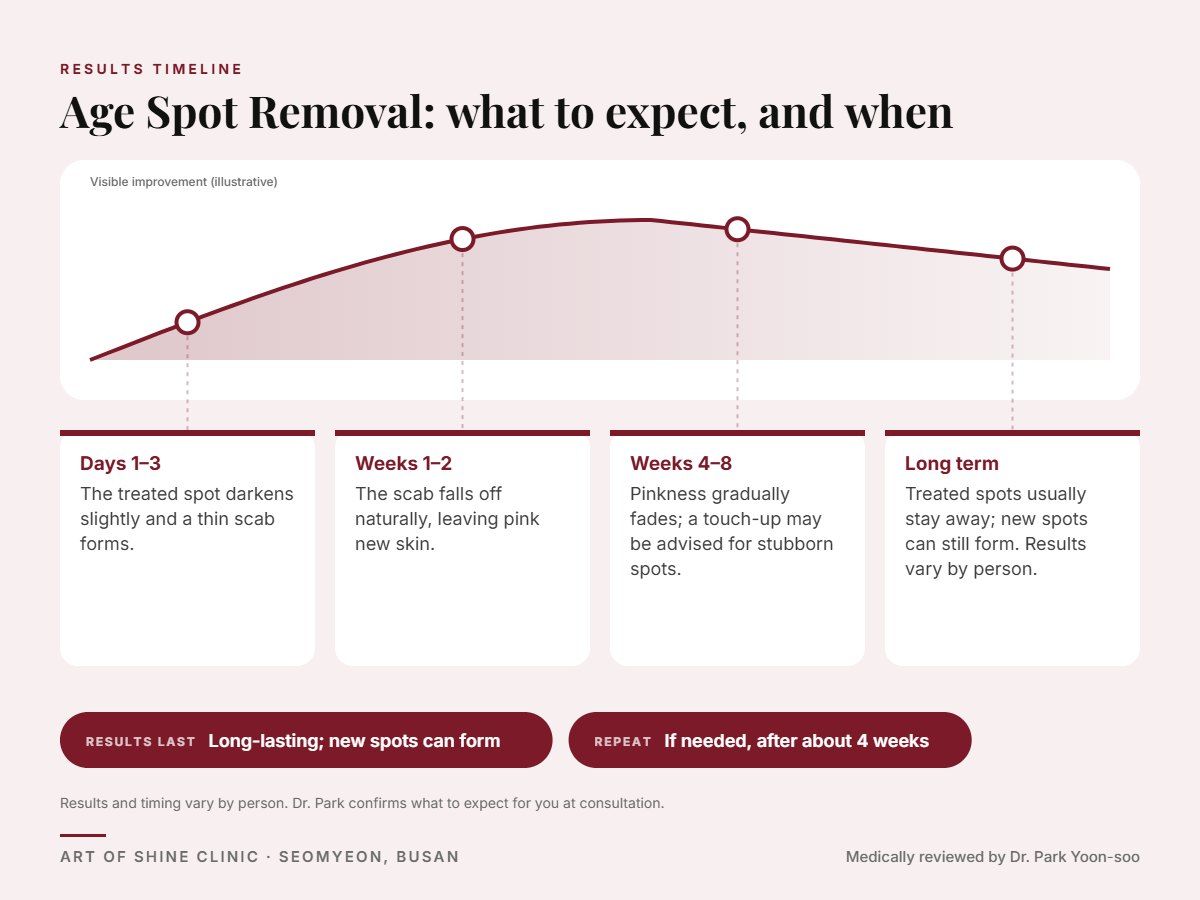
Age Spot Removal results: what to expect and when
- Days 1–3: the treated spot darkens slightly and a thin scab forms.
- Weeks 1–2: the scab falls off naturally, leaving pink new skin.
- Weeks 4–8: pinkness gradually fades; a touch-up may be advised for stubborn spots.
- Long term: treated spots usually stay away; new spots can still form. Results vary by person.
Side effects, risks and who should avoid Age Spot Removal
Laser spot removal is a common procedure, but it does break the skin surface. Possible side effects include:
- Redness, swelling and stinging for a few days
- Scabbing that lasts about 1–2 weeks
- Temporary darkening (post-inflammatory hyperpigmentation), more likely with sun exposure
- Rarely, lighter skin, a small scar or incomplete removal needing another session
Not suitable if you: are pregnant; have an active skin infection, cold sore or open wound in the area; are sunburnt or recently tanned; have used isotretinoin recently; take photosensitising medication; or have a history of keloid scarring. Tell your doctor about any blood thinners or skin conditions.
Age Spot Removal vs Pico Toning, Clarity II and Mole Removal: which should you choose?
Different brown marks need different lasers, so the type of lesion decides.
| Treatment | How it works | Best for | Downtime | Results last |
|---|---|---|---|---|
| Age Spot Removal | Laser (such as CO2) removes raised spots directly | Thick, raised age spots | Scabs for about 1–2 weeks | Semi-permanent; new spots can appear |
| Pico Toning | Picosecond pulses break pigment into fine particles | Flat, widespread pigment, melasma | None | Varies by individual |
| Clarity II | Dual-wavelength laser | Pigment, redness, hair | None | Varies by individual |
| Mole Removal | CO2 laser adjusted to mole depth | Moles | Scabs for about 1–2 weeks | Semi-permanent |
Choose Age Spot Removal for raised spots you can feel. Choose Pico Toning for flat, scattered pigment. Many people do both, which is what the combination packages are for.
Aftercare after Age Spot Removal
- Do not pick or pull off the scab; let it fall off naturally.
- Apply sunscreen thoroughly for 1–2 weeks after treatment.
- Apply the recovery ointment as instructed.
- Some redness may remain after the scab falls off and will gradually fade.
- Avoid saunas, hot baths and strenuous exercise while healing.
Travelling? Read our aftercare tips for travellers.
Downtime after Age Spot Removal, and flying home
Each treated spot forms a small scab within a day or two. Scabs fall off on their own in about 1–2 weeks. Do not pick them. Apply the recovery ointment as instructed. After the scab falls, the new skin may stay pink for a while and gradually fades. You can sightsee straight away, but cover up or use sunscreen thoroughly for 1–2 weeks.
Avoid saunas, jjimjilbang, hot baths and strenuous exercise during recovery. Heavy drinking is best avoided while the scabs heal. Ask Dr. Park when you can apply makeup over the treated spots. Flying with scabs is generally fine. Pack the ointment in your hand luggage. Tell Dr. Park your flight date, especially if you want a follow-up after 4 weeks. See our aftercare tips for travellers.
Age Spot Removal prices in Busan (KRW)
| Package | Regular | Price |
|---|---|---|
| One-Day Spot-Clearing Laser Clarity Laser + Laser Toning + CO2 (Up to 15 Spots) · AOS Skin Package |
KRW 290,000 42% off | |
| Lentigo Removal: 1 Session AOS Skin Package |
KRW 190,000 41% off |
Listed amounts are non-covered treatment fees in Korean won (KRW) and exclude 10% VAT. Payment is made at the clinic on the day of your visit. Costs may vary with the treatment area and dosage, and results, recovery time and side effects differ from person to person. Details are explained during an in-clinic consultation. Event prices and periods change — please confirm on WhatsApp when you book. Prices checked: October 2026.
Full price list → · Current special offers → · How prices & payment work →
Should I do age spot removal or laser toning first?
If you have both raised spots and flat pigment, raised spots are often removed first or in the same visit. Raised spots respond poorly to toning alone, because toning uses low energy. Flat pigment, on the other hand, can be irritated by aggressive removal. That is why combination plans exist, such as the Signature package with Pico Toning x5. The toning course then evens out the tone around the treated spots. Dr. Park decides the order after examining your skin. She also considers how long you are staying in Busan.
Will laser age spot removal leave a scar?
Most people heal without a noticeable scar, but the risk is not zero. Thick spots are removed more deeply, so they take longer to heal. The biggest factors you control are not picking the scab and protecting the area from sun. Picking can leave a mark, and sun on fresh skin can cause temporary darkening. Darker skin tones are more prone to this darkening, so settings are adjusted. If an area stays red or dark for weeks, contact us on WhatsApp. It often fades with time and sun protection.
Can every brown spot be removed with a laser?
No. Laser removal suits benign spots that Dr. Park has examined. Not every brown mark is an age spot. Some are moles, sebaceous hyperplasia or flat pigment such as melasma, and each is treated differently. A spot that has changed quickly, bleeds, itches, or has irregular borders or colours should be medically assessed first. Dr. Park will not laser a lesion she is unsure about. Instead she will advise further checks. Sending clear photos ahead lets her give you an early idea.
Age Spot Removal FAQ
How much does age spot removal cost in Busan?
At Art of Shine Clinic in Seomyeon, a single Lentigo Removal session is KRW 190,000 and the One-Day Spot-Clearing Laser package (up to 15 spots) is KRW 290,000 (excl. 10% VAT).
Does age spot removal hurt?
Numbing cream is applied for about 10–20 minutes first, so most people feel only a warm, snapping sensation. The laser part is quick, usually about 5–15 minutes depending on how many spots are treated.
Will age spots come back after laser removal?
A spot that has been fully removed usually does not return, but new spots can appear with age and sun exposure. Some thick spots need a second session after about 4 weeks. Daily sunscreen helps reduce new spots.
Can I sightsee or fly after age spot removal?
Yes, you can go about your day and fly, but you will have small scabs for about 1–2 weeks. Keep them protected from sun, apply ointment, and plan important photos for after the scabs fall off.
Age spot removal vs Pico Toning: which do I need?
Raised, thick age spots are usually removed directly with a laser such as CO2. Pico Toning uses gentle picosecond pulses for flatter, more widespread pigment and uneven tone. Your doctor may combine both for a more complete result.
Who performs age spot removal?
Treatment is planned by Dr. Park Yoon-soo, Head Director of Art of Shine Clinic. She examines each spot before removal. Ask on WhatsApp who will carry out each step on your visit.
Do foreign patients pay the listed price?
Listed prices are in KRW and exclude 10% VAT, with payment at the clinic on the day. Event prices change, so confirm your price on WhatsApp when you book.
Do I need a consultation before booking spot removal?
The consultation with Dr. Park takes place on the same visit, before treatment. Send clear photos on WhatsApp first so we can tell you whether your spots look suitable and how long to allow.
Related treatments
- Clarity II — dual-wavelength laser for pigment and vessels
- Pico Toning — picosecond laser for flat pigment
- Brighton Toning — toning for an even skin tone
- Helios 4 — gentle toning for melasma and spots
- Mole Removal — precise CO2 laser mole removal
- Milia, Skin Tags & Warts Removal — removes small raised bumps
See all Pigmentation, Tattoo & Hair Removal or browse all 98 treatments.
Age Spot Removal

Brighton Toning

Clarity II
Excel V
Helios 4

Laser Hair Removal (Female)

Laser Hair Removal (Male)
Milia, Skin Tags & Warts Removal

Medically reviewed by
Dr. Park Yoon-soo— Head Director, Art of Shine Clinic Busan
Medical graduate of Kyungpook National University School of Medicine, intern at Asan Medical Center. Rejuran and Rejuviel Expert Member (PharmaResearch), Restylane Expert Member (Galderma), Belotero Key Doctor (Merz Korea) and 2026 Coretox Expert. Member of the Korean Aesthetic Surgery & Laser Society and the Korean Society for Laser, Dermatology and Trichology.
This page is for general information and does not replace an in-person medical consultation. Results, recovery time and side effects vary from person to person.
Ready to plan your visit?
Send one WhatsApp message with the treatment and your travel dates. We reply during clinic hours (KST): Mon–Fri 10:00–20:00, Sat 10:00–16:00.