
Pigmentation, Tattoo & Hair Removal · Seomyeon, Busan
Mole Removal in Busan
#LaserMoleRemoval · #NoScarWorries · #ClearSkin · #SameDayTreatment
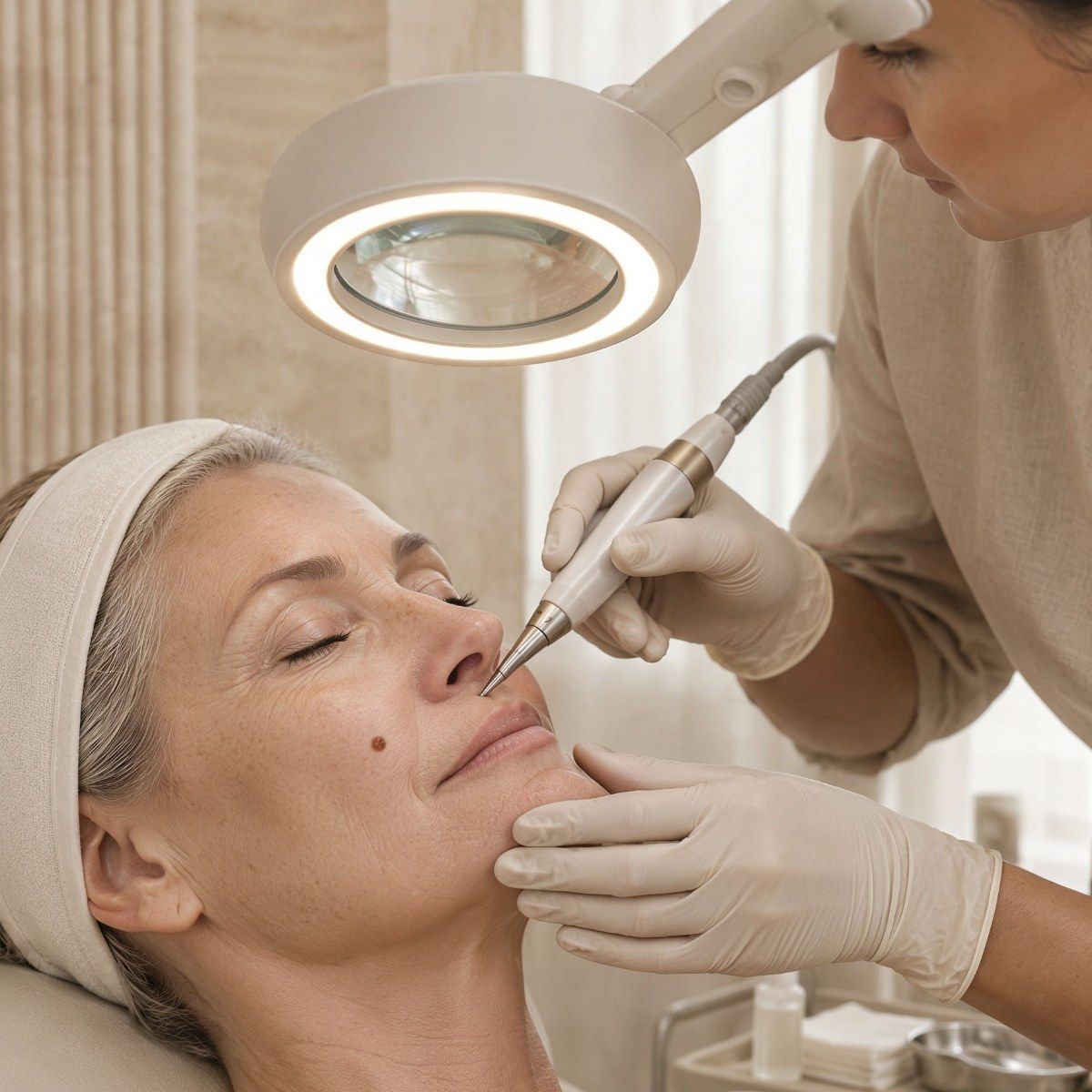
Mole removal uses a CO2 laser to remove moles precisely. The laser intensity is adjusted to each mole's depth and size, keeping the risk of scarring as low as possible for clearer-looking skin.
Quick answer: Mole removal at Art of Shine Clinic in Seomyeon, Busan uses a CO2 laser to vaporise a benign mole layer by layer, with the depth adjusted to its size. After numbing for 10–20 minutes, treatment takes about 5–15 minutes. A small scab falls off in 1–2 weeks and pinkness fades over the following weeks. Deeper moles may need a second session after 4 weeks. Full-face mole removal is KRW 99,000 (excl. 10% VAT).
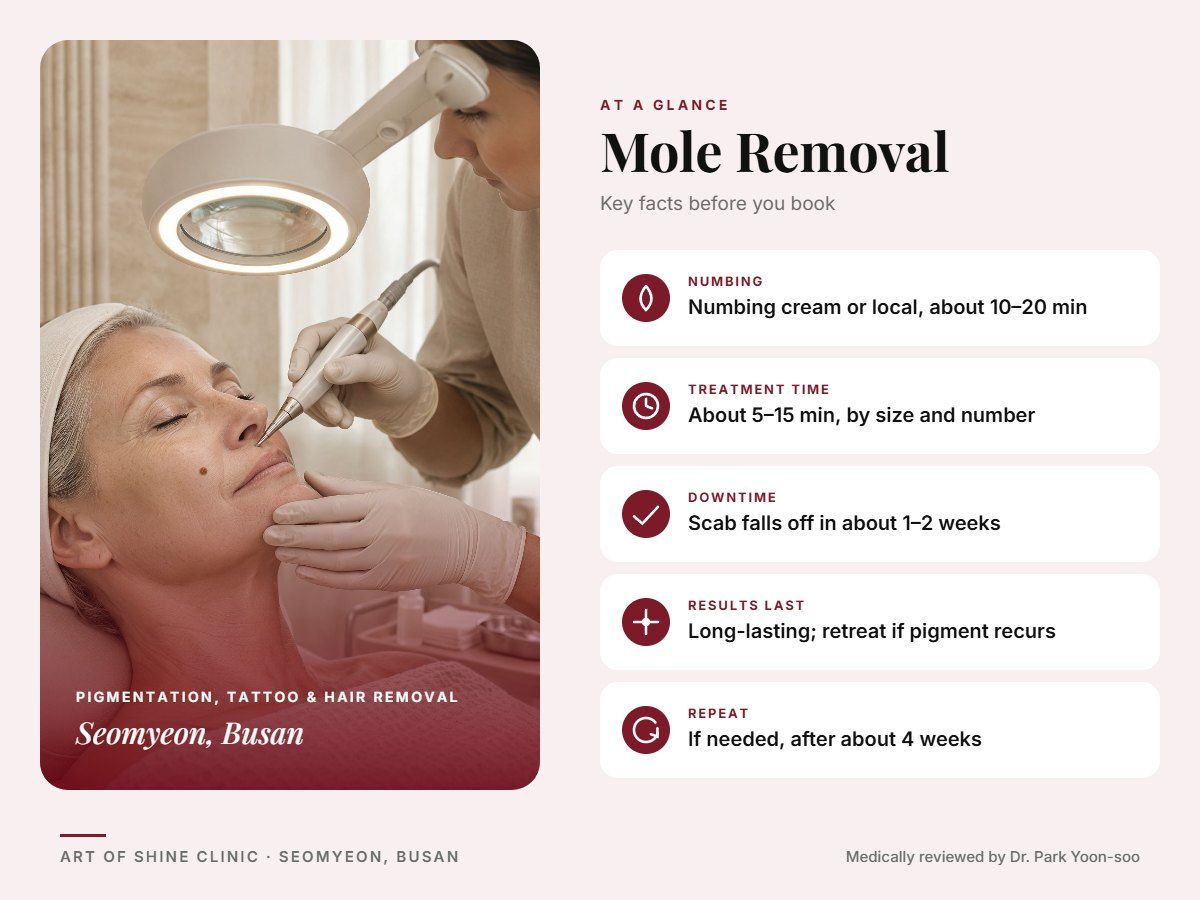
At a glance
Numbing
Treatment time
Downtime
Results last
Repeat
✔ Medically reviewed byDr. Park Yoon-soo, Head Director, Art of Shine Clinic · Last reviewed:

What is Mole Removal?
A mole (naevus) is a cluster of pigment cells in the skin. Flat or raised benign moles can be removed with a CO2 laser, which vaporises tissue in very thin layers. This lets your doctor stop at the depth needed for each mole, which helps limit scarring.
Your doctor first checks every mole you want removed. Moles that are changing, irregular or bleeding should be properly assessed rather than lasered. For flat sun spots see Age Spot Removal, and for other small bumps see Milia, Skin Tags & Warts Removal.
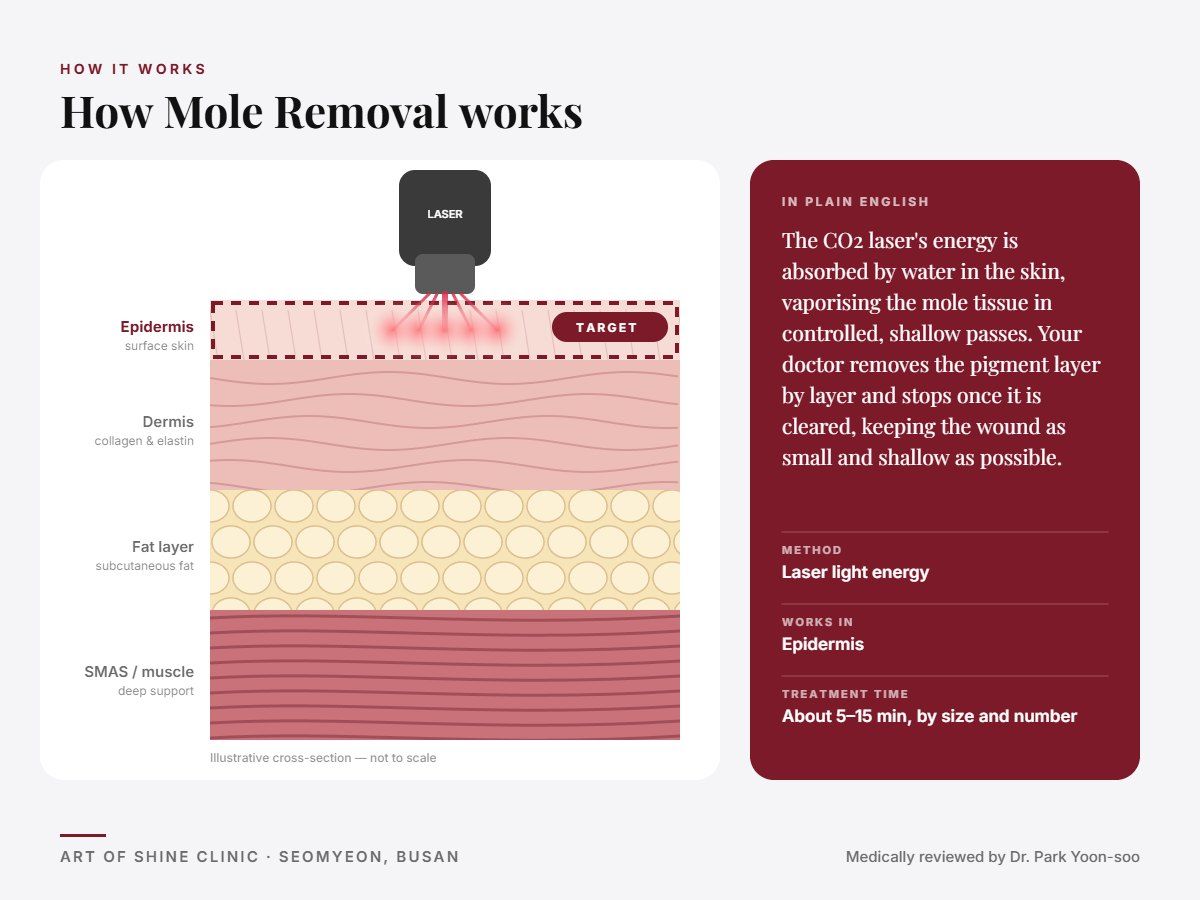
How Mole Removal works
The CO2 laser's energy is absorbed by water in the skin, vaporising the mole tissue in controlled, shallow passes. Your doctor removes the pigment layer by layer and stops once it is cleared, keeping the wound as small and shallow as possible.
- Consultation: your doctor examines each mole, confirms it looks benign and marks those to be removed.
- Treatment: after numbing cream or local anaesthesia (about 10–20 minutes), the moles are removed with the CO2 laser in about 5–15 minutes.
- After: recovery ointment or a small patch is applied, and you can leave the same day with simple wound-care instructions.
Why patients choose Mole Removal
- Precise depth control — the laser is adjusted to each mole's size and depth.
- Minimised scarring risk — shallow, layer-by-layer removal limits damage to surrounding skin.
- Many moles in one visit — small facial moles can be treated together.
- Same-day treatment — consultation and removal can take place in one visit.
Who is Mole Removal for — and when we suggest something else
Good candidates
- People with small, stable moles on the face or body that bother them cosmetically.
- People with raised moles that catch when shaving, washing or wearing clothes.
- People with moles that are hard to cover with makeup.
- Visitors who want a quick removal during a stay in Busan.
- Anyone who can keep scabs clean and protected from the sun for about 1–2 weeks.
We may suggest something else if…
- A mole has recently changed, itches, bleeds, has an irregular border or uneven colour. Dr. Park may advise a medical evaluation instead of laser removal.
- The spot is a flat brown sun spot rather than a mole. Age Spot Removal may suit it better.
- Your concern is widespread freckles or melasma. Pico Toning or Brighton Toning work across the whole face.
- The bump is white or skin-coloured rather than pigmented. Milia, Skin Tags & Warts Removal may be the right page.
- You are heavily tanned or have an active skin infection in the area. We usually wait until it settles.
What happens at your Mole Removal session in Seomyeon
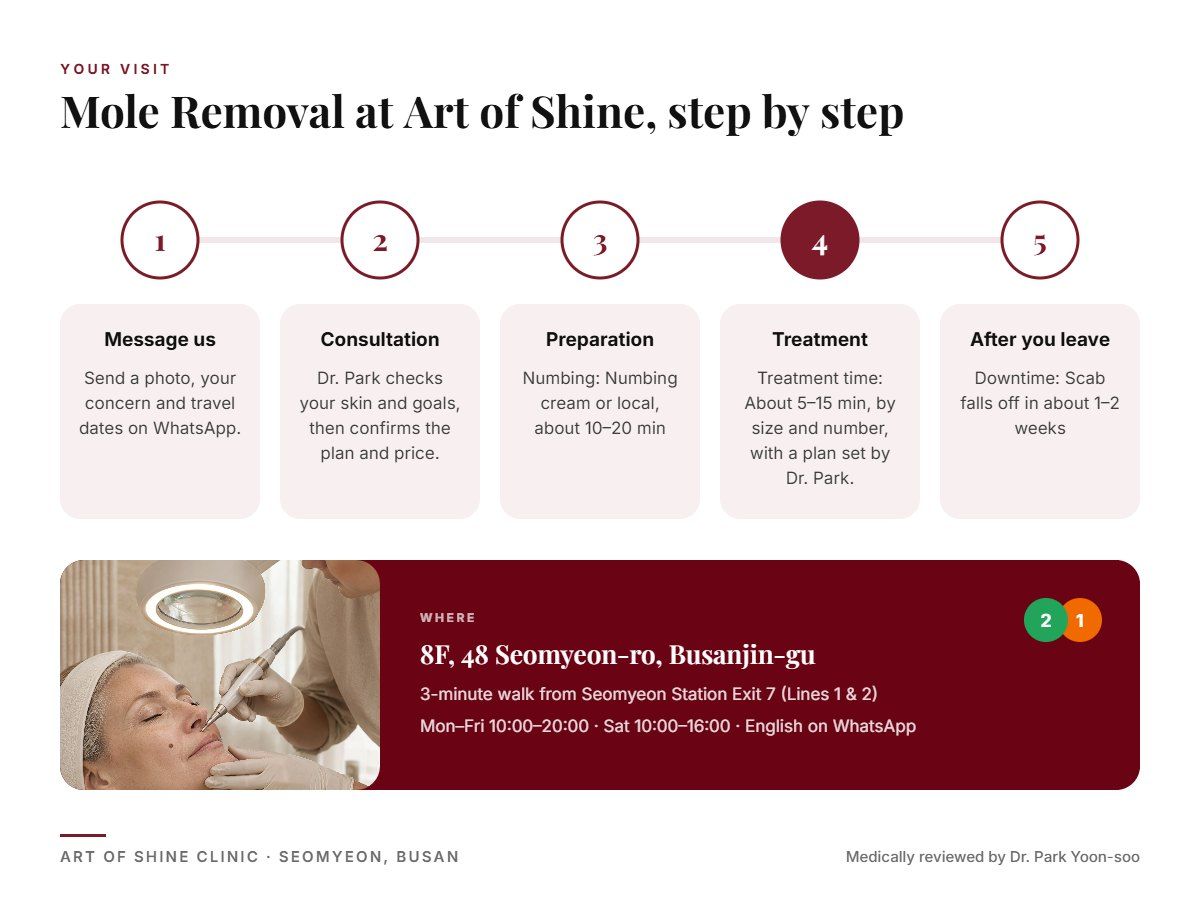
- Message us on WhatsApp first. Send photos of each mole with a coin or ruler for scale. Tell us how long you have had them and whether any have changed.
- Consultation with Dr. Park. She examines each mole for size, depth and any unusual features. She then marks the ones suitable for laser removal today.
- Preparation and numbing. The skin is cleaned and numbed with cream or a small local anaesthetic injection, taking about 10–20 minutes.
- The treatment. The CO2 laser removes the mole layer by layer in about 5–15 minutes in total. You may notice a faint smell and feel slight warmth.
- Out the door and follow-up. A small scab forms and falls off within about 1–2 weeks. Message us after about 4 weeks if any pigment remains.
How Dr. Park plans your mole removal treatment
Moles vary in depth. Flat moles may sit near the surface, while raised moles often extend further down. Dr. Park adjusts the CO2 laser intensity to each mole's depth and size.
She removes pigment gradually rather than in one deep pass. Going too deep can leave a dent or scar, so a deeper mole may be treated conservatively and checked again later. If pigment remains, retreatment is recommended after about 4 weeks.
Our Full-Face Mole Removal package covers multiple facial moles in one visit. Dr. Park still decides individually which moles are suitable.
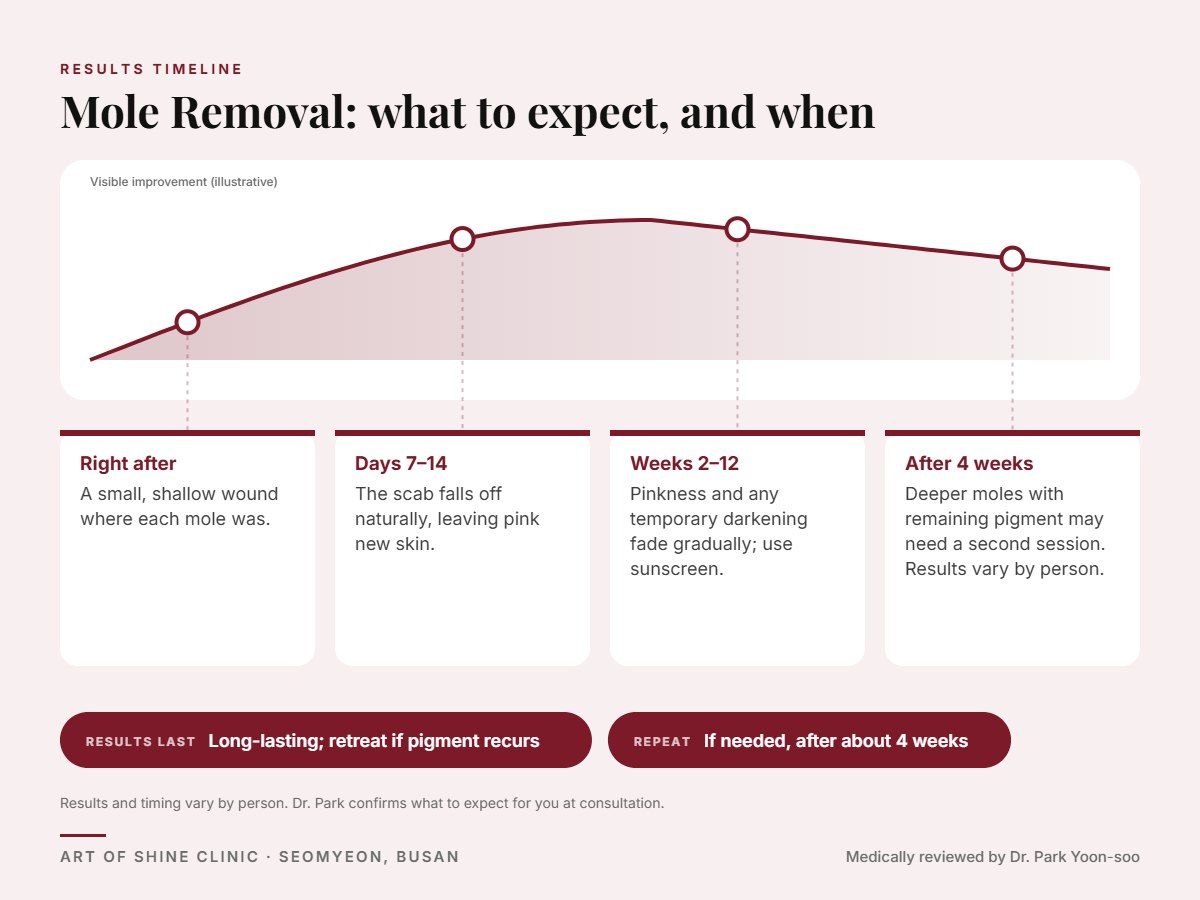
Mole Removal results: what to expect and when
- Right after: a small, shallow wound where each mole was.
- Days 7–14: the scab falls off naturally, leaving pink new skin.
- Weeks 2–12: pinkness and any temporary darkening fade gradually; use sunscreen.
- After 4 weeks: deeper moles with remaining pigment may need a second session. Results vary by person.
Side effects, risks and who should avoid Mole Removal
Laser mole removal is a common procedure. Possible side effects include:
- Redness, a small scab and slight swelling (usually heal within 1–2 weeks)
- Temporary darkening of the treated area, especially with sun exposure
- A small dip or scar, more likely with large or deep moles
- Remaining pigment that may need another session
Not suitable if you: have a mole that is changing in size, shape or colour, bleeding, itching or irregular (it should be assessed first and may need a biopsy rather than laser); have an active infection in the area; tend to form keloid scars; or are pregnant. Tell your doctor about blood thinners.
Mole Removal vs Age Spot Removal, Pico Toning and Milia Removal: which should you choose?
Different pigment problems call for different lasers.
| Treatment | How it works | Best for | Downtime | Results last |
|---|---|---|---|---|
| Mole Removal | CO2 laser removes the mole layer by layer | Raised or flat individual moles | Small scabs for about 1–2 weeks | Semi-permanent; retreat if pigment returns |
| Age Spot Removal | Laser applied according to spot thickness | Age spots from sun and ageing | Small scabs for about 1–2 weeks | Semi-permanent; retreat if they recur |
| Pico Toning | Low-energy picosecond pulses over the whole face | Melasma, freckles and dull tone | None; return to daily life immediately | Varies by person; sessions every 2–4 weeks |
| Milia, Skin Tags & Warts Removal | Laser removal scaled to small growths | White milia, skin tags and warts | Small scabs for about 1–2 weeks | Semi-permanent; new lesions can form |
Choose Mole Removal for distinct moles you can point to. Choose Pico Toning when pigment is spread across the face. If a spot is not clearly a mole, Dr. Park will tell you which page fits.
Aftercare after Mole Removal
- Do not pick the scab; let it fall off naturally.
- Apply sunscreen thoroughly for 1–2 weeks after treatment.
- Apply the recovery ointment regularly, as instructed.
- Pinkness may remain after the scab falls off and fades gradually.
- Avoid saunas, hot baths and strenuous exercise while the skin heals.
Travelling? Read our aftercare tips for travellers.
Downtime after mole removal, and flying home
Each treated mole leaves a small, shallow wound that forms a scab within a day or two. Some patients use a protective patch outdoors. You can sightsee the same day. Apply the recovery ointment, let scabs fall off naturally, and use sunscreen once the area has healed.
Avoid saunas, jjimjilbang, hot baths, swimming and hard exercise until the scabs are gone. Keep alcohol light. Makeup can be used around the spots but not on them. Flying is generally fine. Tell Dr. Park your flight date, as fresh pink skin needs sun protection for weeks. See our aftercare tips for travellers.
Mole Removal prices in Busan (KRW)
| Package | Regular | Price |
|---|---|---|
| Full-Face Mole Removal AOS Skin Package |
KRW 99,000 40% off |
Listed amounts are non-covered treatment fees in Korean won (KRW) and exclude 10% VAT. Payment is made at the clinic on the day of your visit. Costs may vary with the treatment area and dosage, and results, recovery time and side effects differ from person to person. Details are explained during an in-clinic consultation. Event prices and periods change — please confirm on WhatsApp when you book. Prices checked: October 2026.
Full price list → · Current special offers → · How prices & payment work →
Will laser mole removal leave a scar?
Most small moles heal with little visible mark, but some risk of scarring always exists. Right after the scab falls off, the skin looks pink. This redness gradually fades over the following weeks.
The chance of a dent or mark rises with mole depth and size. It also rises if scabs are picked or the area is exposed to strong sun. Dr. Park works conservatively to protect the skin. She may leave a little pigment for a second session rather than go too deep.
Why might my mole need a second session?
Some moles have pigment cells deeper in the skin than the surface suggests. Removing everything in one pass could mean cutting too deep and risking a scar.
Dr. Park prefers a safer first session, then reassessment. If pigment reappears after healing, retreatment is recommended after about 4 weeks. This is common for raised or long-standing moles. A second visit does not mean the first failed. It is part of a careful approach. Plan your trip so a follow-up check is possible if needed.
Which moles should not be removed by laser?
Moles that look unusual should be examined before any cosmetic removal. Warning signs include a recent change in size, an irregular border, several colours, itching or bleeding.
Laser removal vaporises the tissue, so no sample is left for testing. If Dr. Park has any concern about a mole, she will not remove it cosmetically. She will advise a medical evaluation first. Point out any mole you are worried about at your consultation. Photos showing how it looked in the past are also helpful.
Can I remove several facial moles in one visit?
Yes, many people treat several moles at once. Our Full-Face Mole Removal package is designed for this. Treatment usually takes about 5–15 minutes depending on number and size.
More moles mean more small scabs to care for at the same time. If you have an important event or photos soon, Dr. Park may suggest treating the most visible ones first. She checks each mole individually, so not every spot may be included. Any she leaves out will be explained to you at the consultation.
Mole Removal FAQ
How much does mole removal cost in Busan?
At Art of Shine Clinic in Seomyeon, full-face mole removal is KRW 99,000 in our AOS Skin Package (regular KRW 165,000, excl. 10% VAT). The final plan depends on the number, size and depth of your moles, which your doctor checks during the consultation.
Does laser mole removal hurt?
The skin is numbed first with cream or a small local anaesthetic injection, so most people feel only slight heat or a pricking sensation. The laser removal itself takes about 5–15 minutes depending on how many moles are treated.
Will my mole come back after removal?
Most moles do not return once fully removed. Deeper moles may leave some pigment, because your doctor avoids going too deep to protect the skin. A second session after about 4 weeks is sometimes needed. New moles can still appear over time.
Can I go sightseeing or fly after mole removal?
Yes. You can go out and fly as normal. Keep the small scabs clean, apply the ointment or patches as instructed, avoid picking them and protect them from the sun. Skip saunas, hot baths and hard exercise until they heal in about 1–2 weeks.
What is the difference between mole removal and age spot removal?
Moles are clusters of pigment cells that can be raised and sit deeper, so they are usually removed with a CO2 laser. Age spots are flat, sun-related pigment near the surface and are treated with pigment-targeting lasers. Your doctor will tell you which suits each spot.
Can I have mole removal on the same day as my consultation?
Treatment is often available the same day once Dr. Park has examined your moles. Message us on WhatsApp first so we can reserve enough time. We are open Monday to Friday 10:00–20:00 and Saturday 10:00–16:00.
Who performs mole removal?
Dr. Park Yoon-soo, Head Director at Art of Shine Clinic, examines and treats your moles. She graduated from Kyungpook National University School of Medicine and completed her internship at Asan Medical Center.
Do foreign visitors pay the same listed price?
Our listed prices are in KRW and exclude 10% VAT, with payment at the clinic on the day. Event prices change over time, so please confirm the current price on WhatsApp before your visit.
Related treatments
- Age Spot Removal — targeted removal of sun spots
- Brighton Toning — laser toning for a more even tone
- Clarity II — dual-wavelength laser for hair and pigment
- Excel V — laser care for redness and visible vessels
- Milia, Skin Tags & Warts Removal — removes small benign growths
- Sebaceous Hyperplasia Removal — clears small bumps on forehead and nose
See all Pigmentation, Tattoo & Hair Removal or browse all 98 treatments.
Age Spot Removal

Brighton Toning

Clarity II
Excel V
Helios 4

Laser Hair Removal (Female)
Laser Hair Removal (Male)
Milia, Skin Tags & Warts Removal

Medically reviewed by
Dr. Park Yoon-soo— Head Director, Art of Shine Clinic Busan
Medical graduate of Kyungpook National University School of Medicine, intern at Asan Medical Center. Rejuran and Rejuviel Expert Member (PharmaResearch), Restylane Expert Member (Galderma), Belotero Key Doctor (Merz Korea) and 2026 Coretox Expert. Member of the Korean Aesthetic Surgery & Laser Society and the Korean Society for Laser, Dermatology and Trichology.
This page is for general information and does not replace an in-person medical consultation. Results, recovery time and side effects vary from person to person.
Ready to plan your visit?
Send one WhatsApp message with the treatment and your travel dates. We reply during clinic hours (KST): Mon–Fri 10:00–20:00, Sat 10:00–16:00.